Three Heat Pump Lessons

I love my heat pump. I love that one device can heat and cool my entire house, without burning gas. I love knowing that it's incredibly efficient, actually consuming less energy than it's moving. I also love the more even heating and cooling it provides. But if I had it to do again I'd do things differently.
| Location | NW Toronto | Design Temperature | -20° C |
| Year Built | 1918 | Size | 2000 ft2, 2 stories + finished basement, detached |
| Construction | Brick, lath & plaster walls | Heating / cooling | Forced air |
Total project cost
$14,520.50 after tax
- $7,100.00 Ontario heat pump rebate
= $7,420.50 net
Lesson 1: Selecting the right installer is crucial.
Finding a good contractor for anything is hard enough. You can go to a site like HomeStars and read reviews, look at some details of actual projects completed, see if anything matches aspects of the project you have in mind. But reviewers are generally not experts in the work they're reviewing. The reviews might reflect whether the contractor made the client comfortable and satisfied with the work, which is not the same as whether they made the best choices.
We went to HomeStars, found an HVAC contractor with good reviews, and with multiple mentions of heat pump installation projects. This is a start, as many HVAC contractors will tell you heat pumps don't work in Canada, aren't worth the money, etc. This advice is based on the heat pumps that existed a long time ago and is no longer valid (just look at the prevalence of heat pumps in Norway).
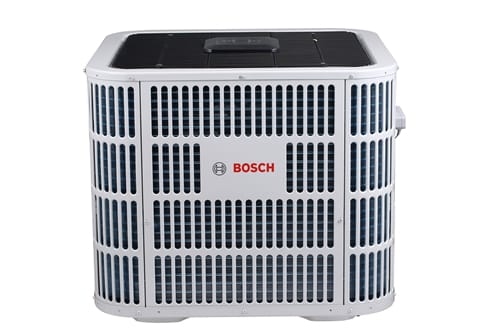
While I think our installer did a good job and sold us good equipment, in hindsight they were not the best advisors in this transition. They offered us one (Bosch) system, no doubt the same system they'd installed in other homes, maybe due to existing relationships with the company. They sized the system based on the gas furnace we were replacing (not considering our actual energy usage or the fact that we'd made the home significantly more energy efficient since that furnace was installed.) They installed a new thermostat which is not capable of running the heat pump at less than 100%, although the heat pump itself is capable of running at any level.
Worst of all, they installed a new gas furnace as an auxiliary heat source. More on that below.
Choose an installer who doesn't just understand heat pumps, but keeps up with the latest models, doesn't put too much faith in the traditional capacity calculations, really understands the differences from gas systems, and considers (and advises you on) your needs and priorities. Many installers are used to dealing with clients for whom the lowest up front cost is the only priority.
Lesson 2: Know what you actually need.
I wish I'd learned more about two things before starting this process: the actual system capacity I need, and the features I needed to control the system effectively.
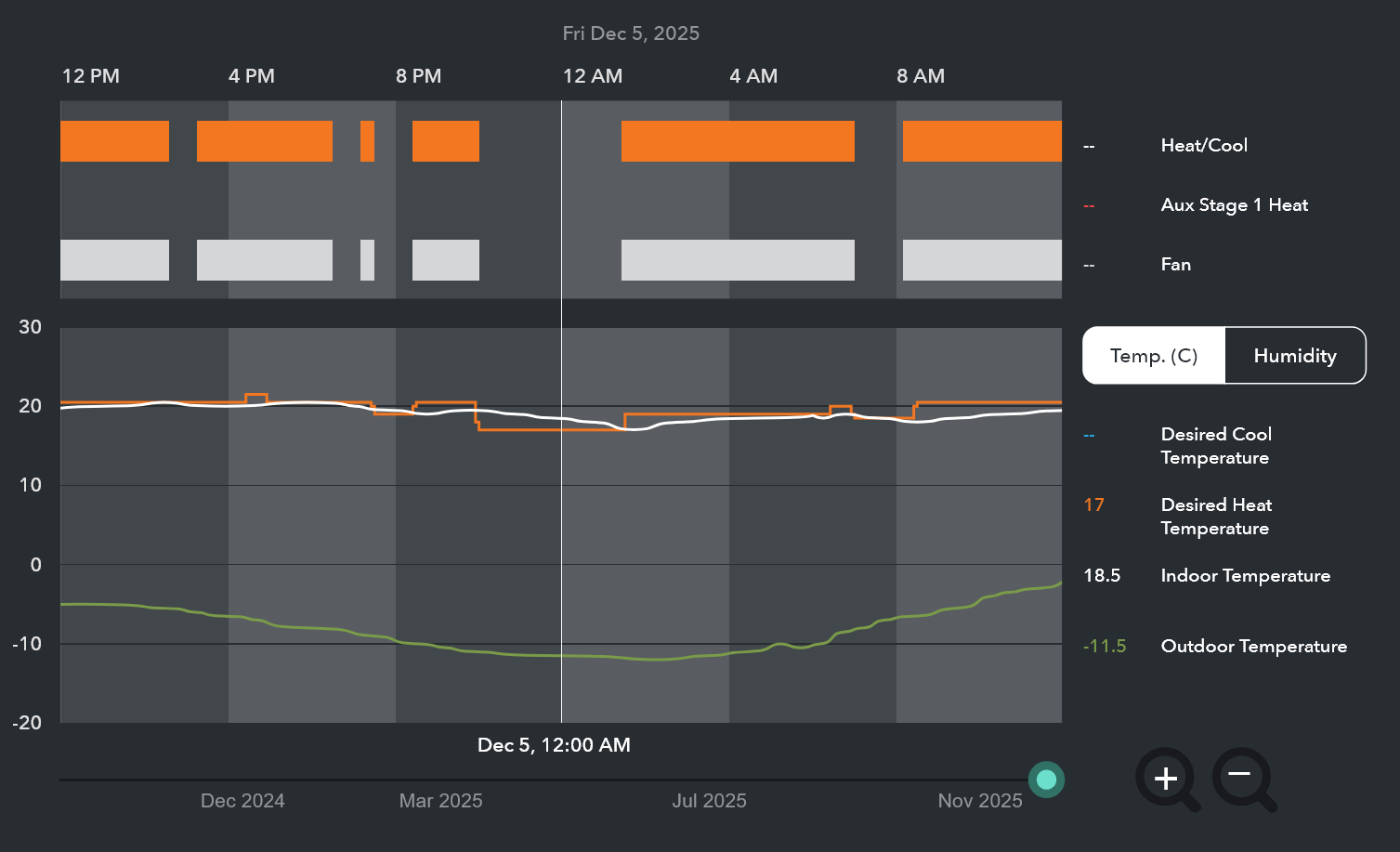
I may have a heat pump that's far too large for my house. I'm not really sure. My usage on a very cold Toronto morning looks like this:
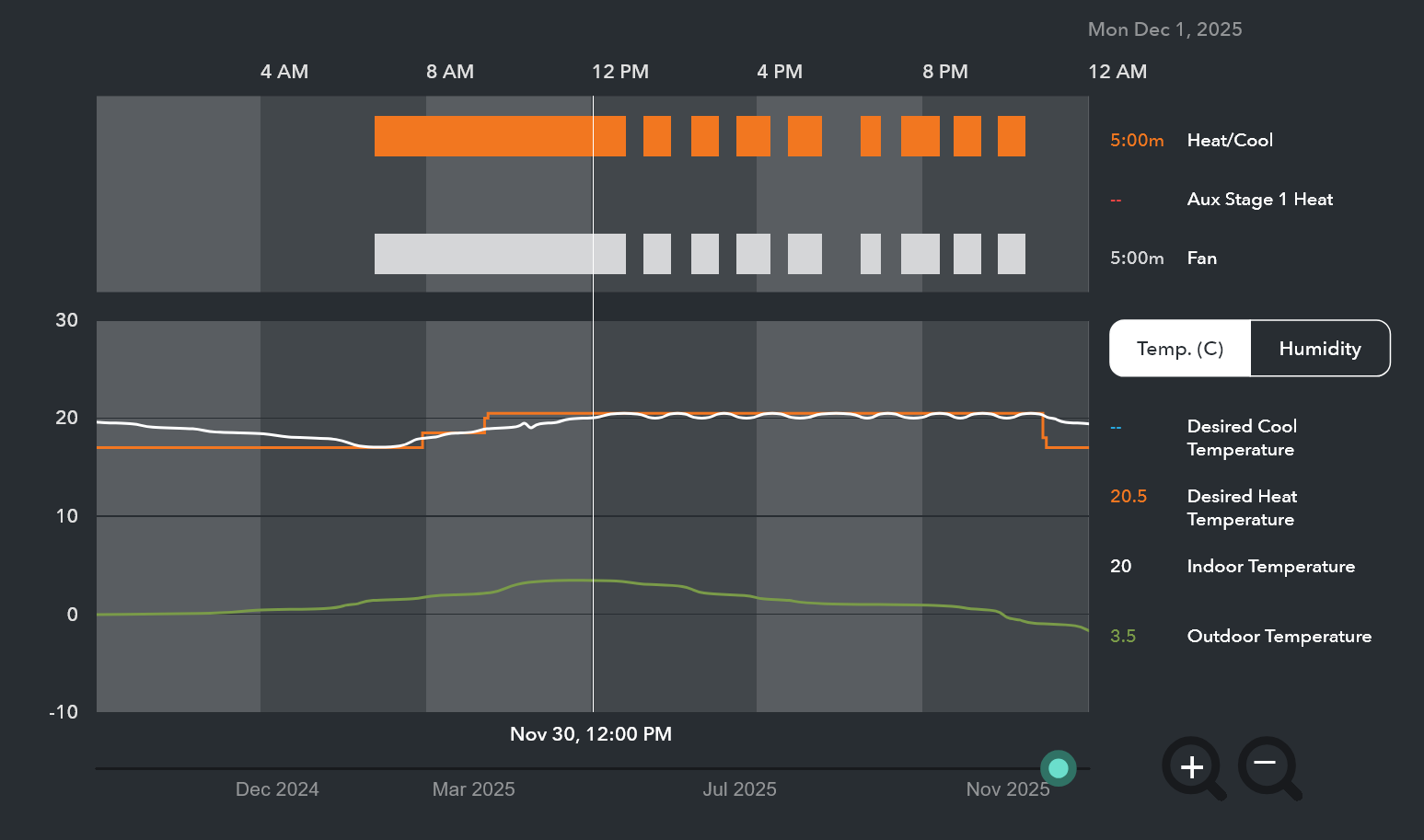
while a more normal winter day looks like this:
and on a Fall day with the set temperature mostly constant:
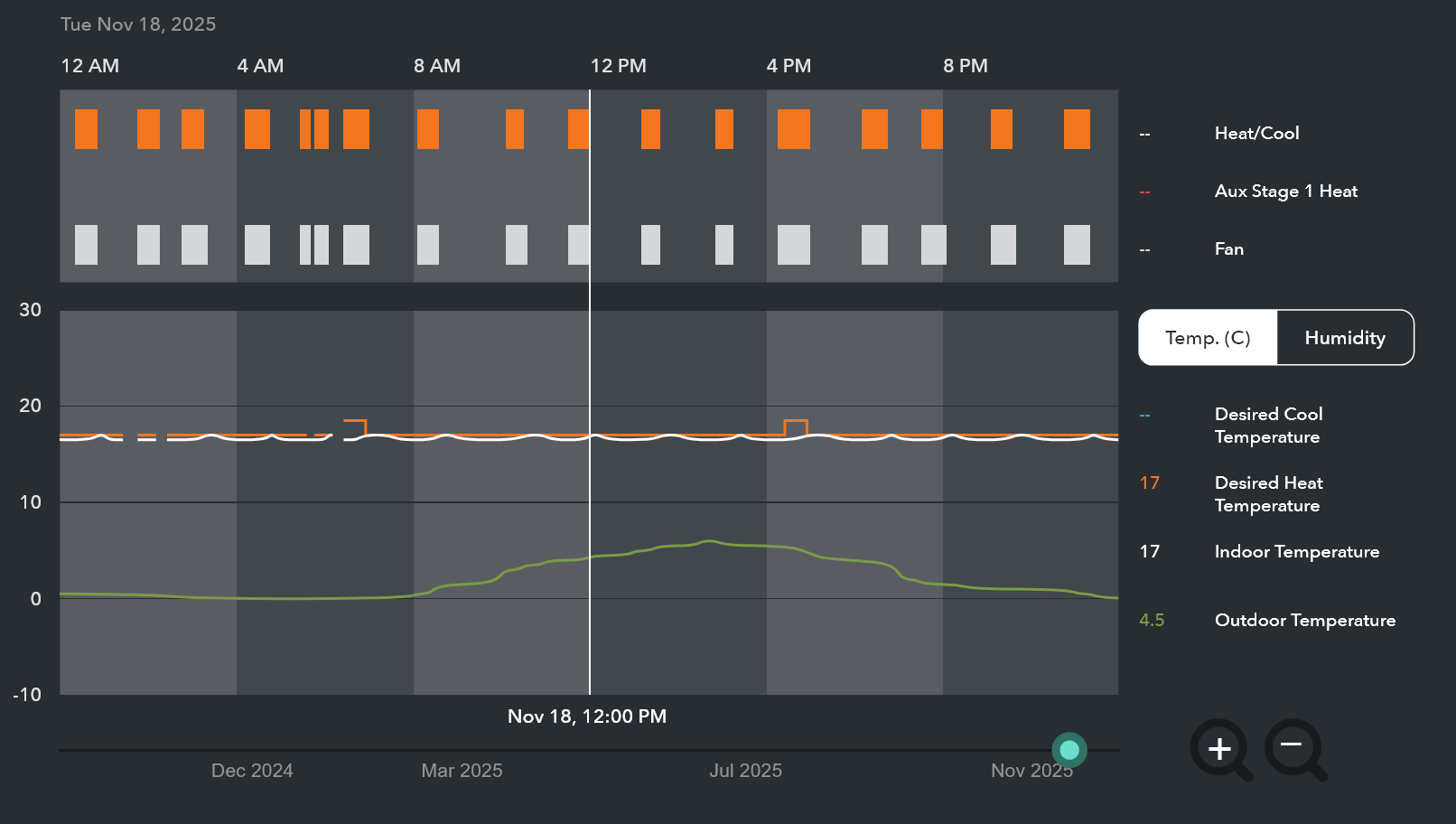
Notice the gaps in the orange line. The heat pump is running at 100% capacity when the line is orange, and not running otherwise. With heat pumps it's important to run them for long periods rather than "short cycling" them (turning them on and off for shorter periods) for efficiency.
But my real problem might be in control. My heat pump is capable of running at any percentage capacity, but my thermostat (while it does make pretty graphs) can only turn it on at 100%. I feel like this was a major oversight and I'm planning to bring a different HVAC company in to upgrade my thermostat. The heat pump should drop to a lower level (like 40%) and continue running rather than switching off.
Lesson 3: Think about the long term. No, longer.
These systems last for decades. I knew that I wanted a heat pump, but I didn't think about the fact that within the next several years (well within the expected lifespan of the system) I can fully electrify my home if I work toward it.
Our contractors installed a new gas furnace as an auxiliary heat source. We have never needed to use it for heating (in fact I've had to change the thermostat settings to prevent it from coming on when it's not needed), but the fact that it's another appliance preventing us from disconnecting our gas service entirely is not great. I didn't realize at the time that I should be working toward full electrification, and they never brought up this consideration. (Do we even need an auxiliary heat source? We didn't have one before, and the heat pump is effective well into the coldest Toronto temperatures.)
I wish I'd thought this through so that from the start I could have asked for a properly sized heat pump, electric auxiliary heat, and a thermostat that can control the heat pump's capacity dynamically.
Update: January 2026 record lows
With -20°C low temperatures, I'm no longer concerned that my heat pump is too large. It runs constantly when external temperatures are in the teens, both because as a heat pump that is not cold climate rated it starts to lose effectiveness in this range, and because our insulation is still fairly poor.
I also need to use my aux heat below around -15°C. If I rely on the heat pump alone below this temperature it struggles to meet my thermostat's targets (17°C at night, 20.5°C in the day). This makes me really wish I had resistive electric aux heat, so that I could continue to heat without burning gas, but also because I can't run the heat pump and the methane furnace at the same time. I believe resistive aux heat would be additive.
All that said, I still have no regrets about switching to a heat pump for my primary home heating, even in these record low temperatures. My system is working and keeping my house comfortable.